Open the game ▸

Grade 2 Maths Games for Kids Learning Through Play with MathQuest

Practical Year 2 maths, explained simply for parents

By Grade 2, children are using bigger numbers and more reliable strategies to solve problems. They begin thinking in hundreds, tens and ones, understanding halves and quarters, and seeing how groups of objects relate to multiplication. Maths starts showing up in money, calendars and everyday decisions.

MathQuest is designed around short adventures where children use maths to solve problems and keep exploring. This guide explains what your child is learning, why the skills matter and how you can help without turning home into another classroom.

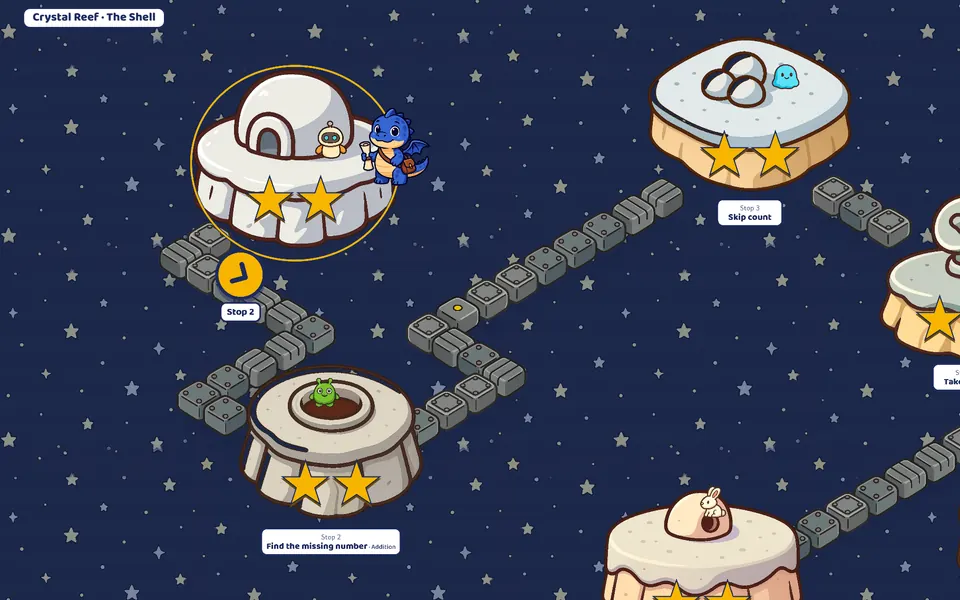
A Year 2 map in MathQuest: islands under a starry night sky joined by a stone path, each island a game, with Daviel the dragon on the first one.

What maths does your child learn in Grade 2?

The Australian Curriculum calls this level Year 2. The six areas below translate its maths content into everyday language. Children work through these ideas over the year, at different speeds. They are not a test you need to give your child at home.

1. Understanding numbers to at least 1,000
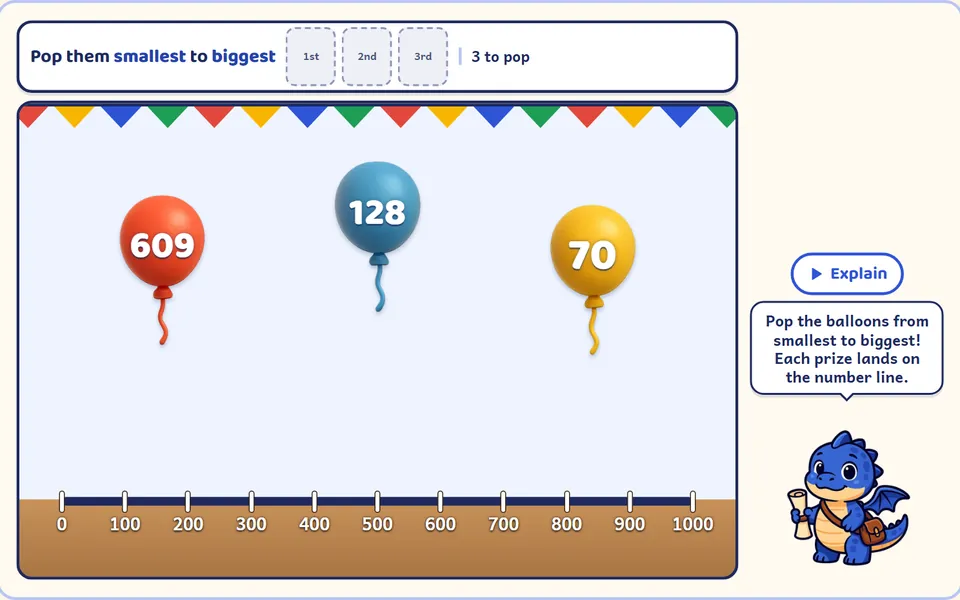
Balloon Pop in MathQuest: balloons numbered 609, 128 and 70 to pop from smallest to biggest, above a number line to 1,000.

What is your child learning?

Children read, order and represent numbers to at least 1,000. They begin to split three-digit numbers into hundreds, tens and ones, and learn that the same number can be grouped in different ways. For example, 346 can be three hundreds, four tens and six ones.

This matters because a strong sense of place value makes later calculations easier. A zero matters too: 306 isn't the same as 36. Working with physical objects and drawings can make these ideas less abstract.

How MathQuest helps

Balloon Pop asks children to pop numbers up to 1,000 in order, smallest first. Place value asks which digit is in the hundreds, tens or ones place.

MathQuest games: Balloon Pop, Place value

Try it at home

Use paper squares for hundreds, strips for tens and dots for ones. Build 205 and 250 and ask what changed. Spot three-digit numbers on signs and receipts. The iPhone clock is a good place for a spot test.

Australian Curriculum: AC9M2N01, AC9M2N02
2. Adding, subtracting and making sense of money

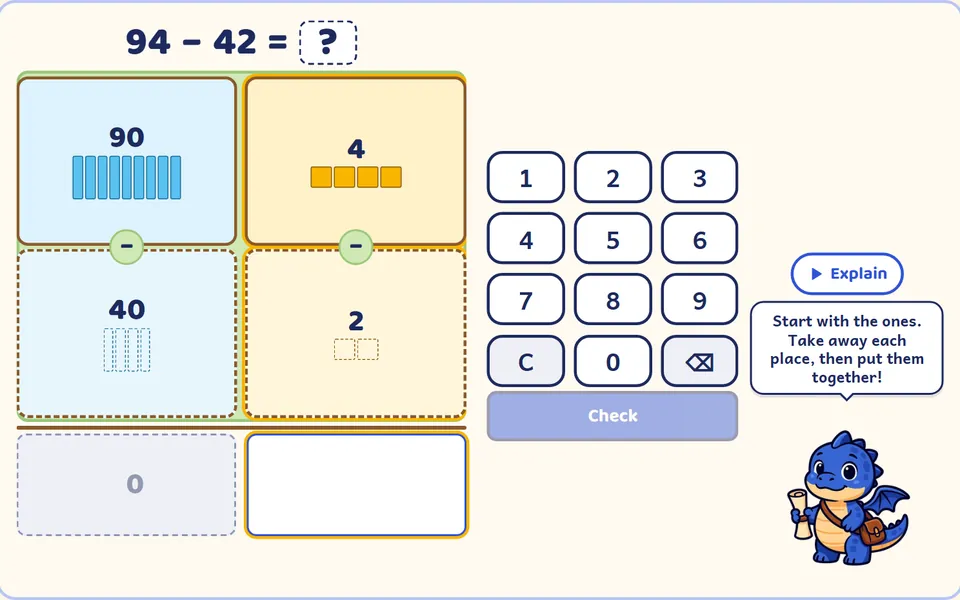
Take away in MathQuest: 94 - 42 laid out as tens and ones, with a number pad to work each place.

What is your child learning?

Grade 2 children add and subtract one- and two-digit numbers using different strategies. They also apply maths to simple everyday situations, such as working out a total or change in a pretend shop.

The useful part is being able to explain a method. To add 28 and 15, a child might add 10 first and then 5. That is often more meaningful than guessing or trying to remember a written procedure.

How MathQuest helps

Take away works through two-digit subtraction one place at a time, ones first, including taking from the tens when the ones run short. Adding numbers practises adding two-digit numbers, with and without regrouping, and in Money children count up a handful of coins.

MathQuest games: Take away, Adding numbers, Money

Try it at home

Set up a pretend shop with price tags in whole dollars. Let your child buy two items and calculate the total. Talk about how they checked their answer.

Australian Curriculum: AC9M2N04, AC9M2N06, AC9M2A02

3. Equal groups, doubling and the twos facts

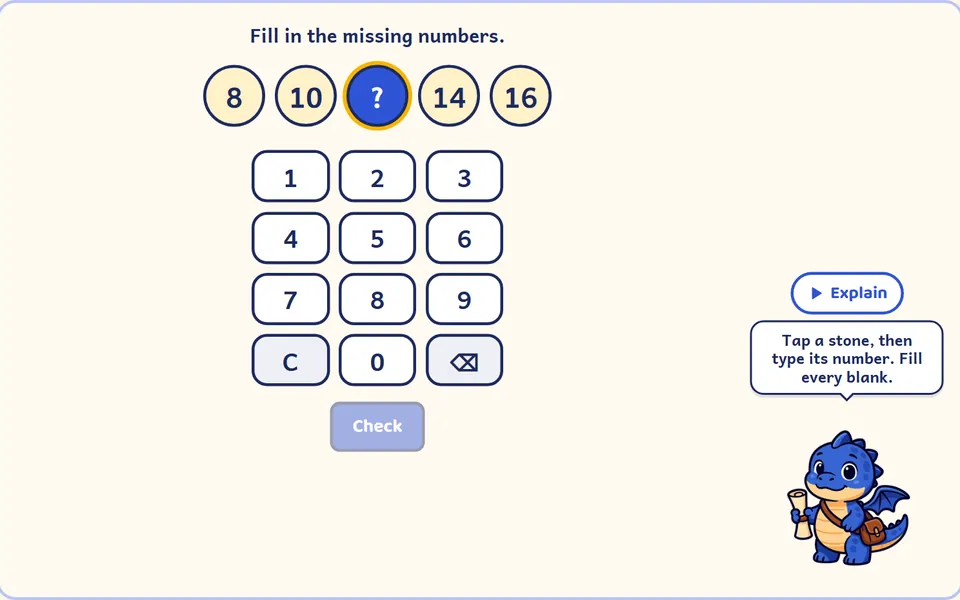
Skip count in MathQuest: counting by twos, 8, 10, ?, 14, 16, with a number pad to fill the gap.

What is your child learning?

Children explore multiplication and division using repeated addition, equal groups and arrays. They practise facts for twos and the related division facts, making connections between doubling and halving.

For example, four pairs of socks can be counted as 2, 4, 6, 8. Seeing the pairs helps children understand what four times two means, rather than simply chanting an answer.

How MathQuest helps

Children skip count by twos in Skip count and Lily Pad Leap, and practise dividing by 2 in Divide by X.

MathQuest games: Skip count, Lily Pad Leap, Divide by X

Try it at home

Arrange buttons in pairs or equal rows. Ask how many there are altogether and whether a different arrangement gives the same total.

Australian Curriculum: AC9M2N05, AC9M2A03

4. Halves, quarters and eighths

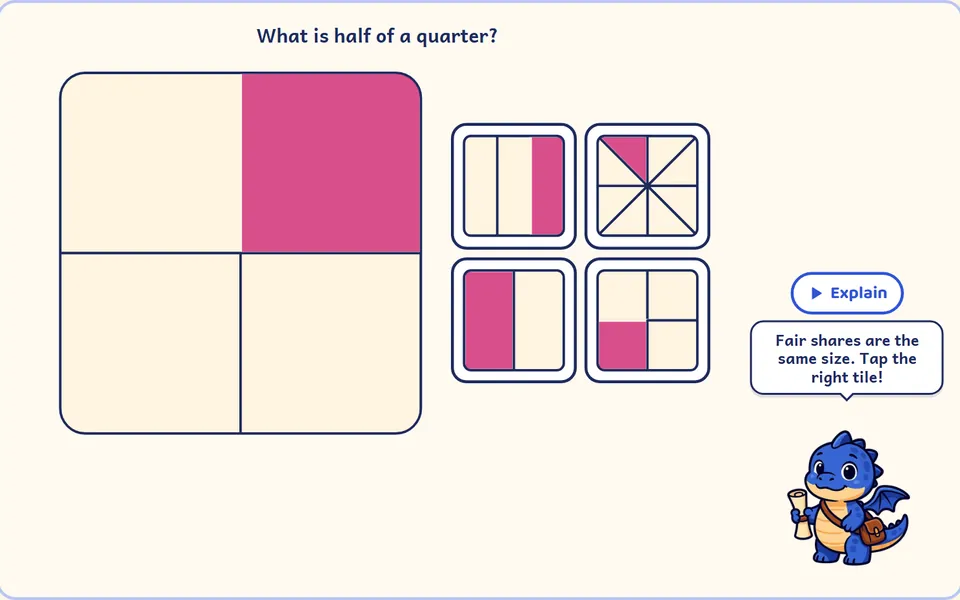
Fair shares in MathQuest: a square cut into four equal parts with one quarter coloured, the question "What is half of a quarter?" and four picture tiles to choose from.

What is your child learning?

In Grade 2, children begin recognising halves, quarters and eighths as equal parts of a whole. They learn that two halves make one whole, and that repeated halving can create four or eight equal parts.

The word equal is essential. Cutting a sandwich into four pieces doesn't automatically make quarters unless the pieces are the same size. Children learn to notice and explain that difference.

How MathQuest helps

Fair shares asks children to pick the picture that shows halves or quarters, to shade a half, a quarter or an eighth of a shape, to find half of a half and half of a quarter, and to colour half or a quarter of a group of things such as shells.

MathQuest games: Fair shares

Try it at home

Fold paper in half, then half again. Share a sandwich or an apple equally and ask what each piece is called. Draw the pieces to compare them.

Australian Curriculum: AC9M2N03, AC9M2M02

5. Time, measuring and everyday comparisons

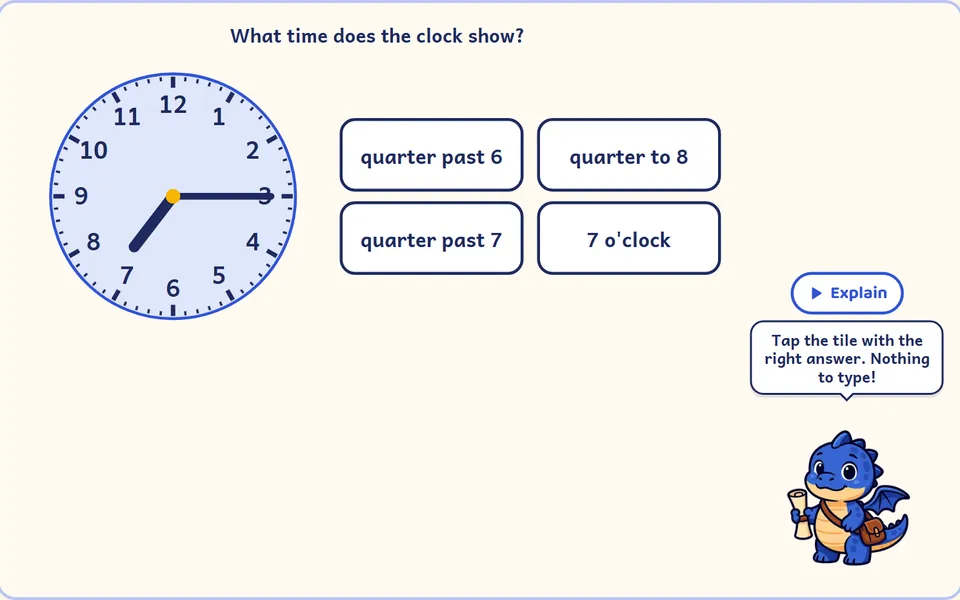
Tell the time in MathQuest: an analogue clock showing quarter past seven, and four times to choose from.

What is your child learning?

Children measure and compare length, weight and capacity using consistent units. They learn to use a calendar to find the days between events and read an analogue clock to the hour, half-hour and quarter-hour.

These skills come alive when children can connect them to their day: how long until lunch, whether one bottle holds more than another, or which ribbon is longer.

How MathQuest helps

Tell the time asks children to read an analogue clock to the hour, half hour and quarter hour.

MathQuest games: Tell the time

Try it at home

Use a family calendar to count days until an outing. Draw a clock face and move its hands to quarter past and half past. Measure two objects using identical blocks.

Australian Curriculum: AC9M2M01, AC9M2M03, AC9M2M04

6. Shapes, maps, patterns and data

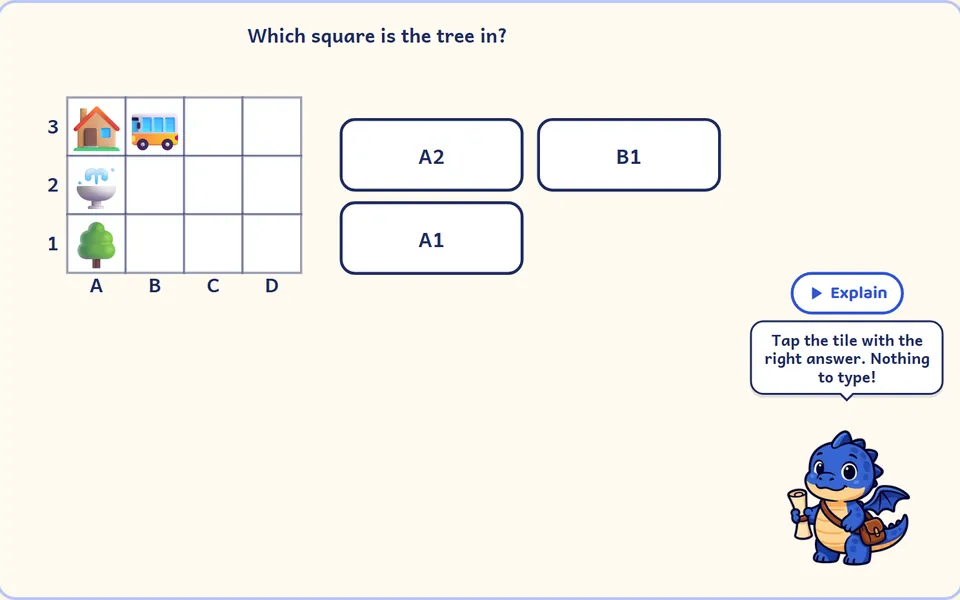
Find the spot in MathQuest: a small grid map with a house, a bus and a tree, and the question "Which square is the tree in?".

What is your child learning?

Children describe shapes more precisely, using ideas such as curved and straight sides. They follow routes on simple maps, continue patterns that increase by a constant amount and collect information that can be shown in graphs.

You might see this when a child notices that a staircase of numbers grows by three every time, or when they can explain which of two shapes has straight sides.

How MathQuest helps

How many sides? and Sort the shapes ask how many sides a shape has and which sides are parallel. Find the spot asks children to find a square on a simple map and to pick the route to a star. Patterns and Lily Pad Leap use steps that grow by the same amount each time, and Read the graph asks which animal a picture graph shows the most of.

MathQuest games: How many sides?, Sort the shapes, Find the spot, Patterns, Lily Pad Leap, Read the graph

Try it at home

Draw a map of the living room, then give directions to a hidden toy. Make a tally of favourite snacks and turn it into a picture graph. Ask what the information tells you.

Australian Curriculum: AC9M2SP01, AC9M2SP02, AC9M2A01, AC9M2ST01, AC9M2ST02

Why MathQuest? Maths with a reason to keep exploring

Children are more likely to engage when a problem has a purpose. In MathQuest, each game finished moves your child along the map to the next island, and each map ends with a boss level.

Each game is five questions, usually a minute or two, so it is easy to fit into family life.

Skills come back on later maps, in different games and in each map's boss level, so children keep practising what they have learnt. That repetition is deliberate: understanding is built by practising and recognising a familiar idea. Our aim is for children to want another game because they're enjoying themselves.

Learning continues beyond the screen

Maths in a game should connect with maths in daily life. Talking about prices, following directions, comparing measurements and explaining a calculation are simple ways for parents to reinforce what children explore in MathQuest.

How can you help your Grade 2 child at home?

You don't have to reteach the school day. Choose one ordinary activity and ask your child to explain their thinking. You might say, “How did you work that out?” or “Does that answer seem about right?” Let them use drawings, objects, a number line or another method that makes sense to them.

Keep it relaxed. When children are tired or frustrated, another time may work better. The point is to make the learning feel understandable and useful, not to race through worksheets.

Common questions from parents

What should my child know in Grade 2 maths?

The Year 2 Australian Curriculum includes the number, operations, patterns, measurement, space and data concepts explained above. Children learn these across the school year. Ask your child's teacher which skills are being taught now and what support would be helpful.

Is Grade 2 the same as Year 2?

Yes. In Victoria, families often say Grade 2. The Australian Curriculum calls the same year level Year 2.

What if my child finds a topic difficult?

Start with a smaller number or simpler example. Try drawing the problem or using objects to show what's happening. If difficulty continues or is affecting your child's confidence, their teacher can help identify a suitable next step.

Does my child need to practise maths every day?

There is no single practice length that suits every child. A short, useful activity at a relaxed time can be easier to repeat than a long session. Follow your child's needs and their teacher's guidance.

Does MathQuest replace maths lessons?

No. MathQuest is intended to complement classroom learning and give children another way to practise and apply maths through play.

Let their next maths adventure begin

Whether your child is learning a new number strategy, reading a clock or reasoning through a measurement problem, every small success is another step forward. MathQuest aims to make those moments part of an enjoyable adventure.

Short games. Real maths skills. A world waiting to be explored.

The first six games are free with a free account. After that, MathQuest is $4.99 a month or $29 a year.