Open the game ▸

Grade 4 Maths Games for Kids Learning Through Play with MathQuest

Practical Year 4 maths, explained simply for parents

By Grade 4, children begin putting more of their maths knowledge together. Place value now includes decimal numbers, multiplication and division become more fluent, and children use fractions, measurement and maps to solve richer problems.

MathQuest is designed around short adventures where children use maths to solve problems and keep exploring. This guide explains what your child is learning, why the skills matter and how you can help without turning home into another classroom.

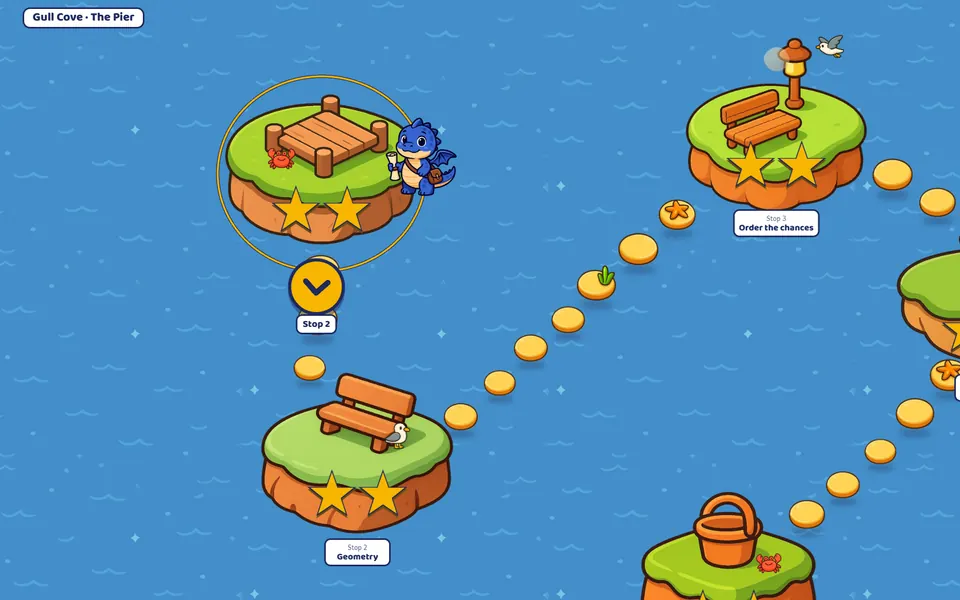
A Year 4 map in MathQuest: islands on the sea joined by a path of stepping stones, each island a game, with Daviel the dragon on the first one.

What maths does your child learn in Grade 4?

The Australian Curriculum calls this level Year 4. The six areas below translate its maths content into everyday language. Children work through these ideas over the year, at different speeds. They are not a test you need to give your child at home.

1. Decimal place value: tenths and hundredths
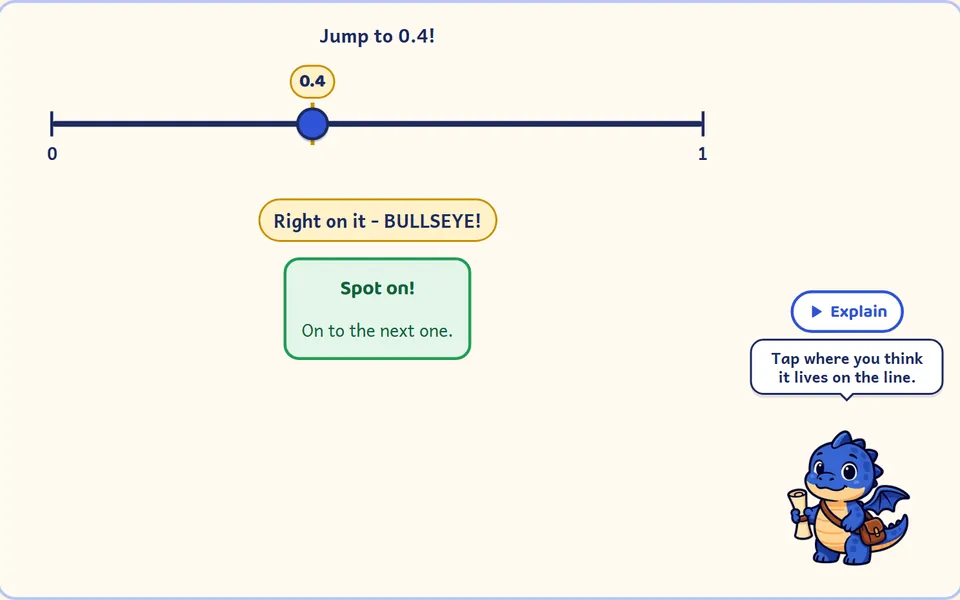
Number-Line Jump in MathQuest: 0.4 placed on a line from 0 to 1, with "Right on it - BULLSEYE!".

What is your child learning?

Children extend place value into decimal numbers. A number such as 3.45 has three whole units, four tenths and five hundredths. Children learn that the position of each digit matters.

They can also see how multiplying by ten changes a number's place value. Money is one familiar way to show decimals, though the learning goes beyond dollars and cents.

How MathQuest helps

Balloon Pop asks children to order decimals with tenths and hundredths, Number-Line Jump has them place a decimal on a number line, and Place value asks them to multiply and divide by 10, 100 and 1000.

MathQuest games: Balloon Pop, Number-Line Jump, Place value

Try it at home

Compare $3.40 and $3.04, then draw the numbers using place-value columns. Ask why the first value is bigger.

Australian Curriculum: AC9M4N01, AC9M4N05
2. Using the four operations with confidence

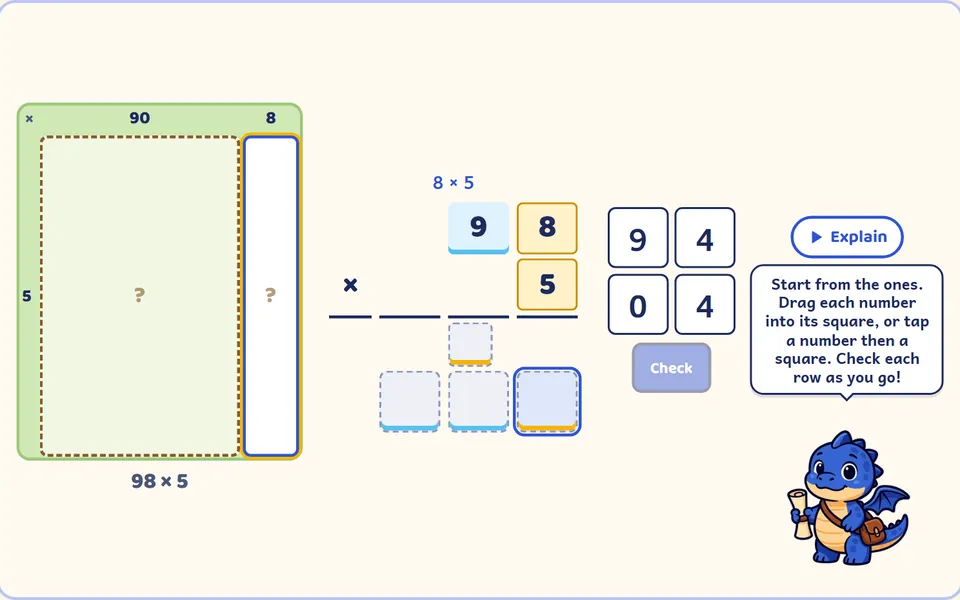
Long multiplication in MathQuest: 98 × 5 worked as an area model, with digits to drag into place.

What is your child learning?

Children add and subtract with greater efficiency and use multiplication and division facts up to 10 × 10. They learn to choose a method suited to the problem and decide whether their answer is reasonable.

For instance, 48 objects can be shared into six equal groups. Children can draw groups, use a known times-table fact or work backwards from division to multiplication.

How MathQuest helps

Children practise every times table to 10 × 10 and the matching division facts in Recall and Divide by X. They subtract three-digit numbers one place at a time in Take away, find unknowns in Find the missing number, multiply step by step in Long multiplication, round to check answers in Round it, and work out change in Money.

MathQuest games: Recall, Divide by X, Take away, Find the missing number, Long multiplication, Round it, Money

Try it at home

Make equal rows with blocks and compare strategies. Ask, “Is 48 divided by six closer to five or fifty?” before calculating.

Australian Curriculum: AC9M4N06, AC9M4N07, AC9M4N08, AC9M4A02

3. Fractions and their decimal connections

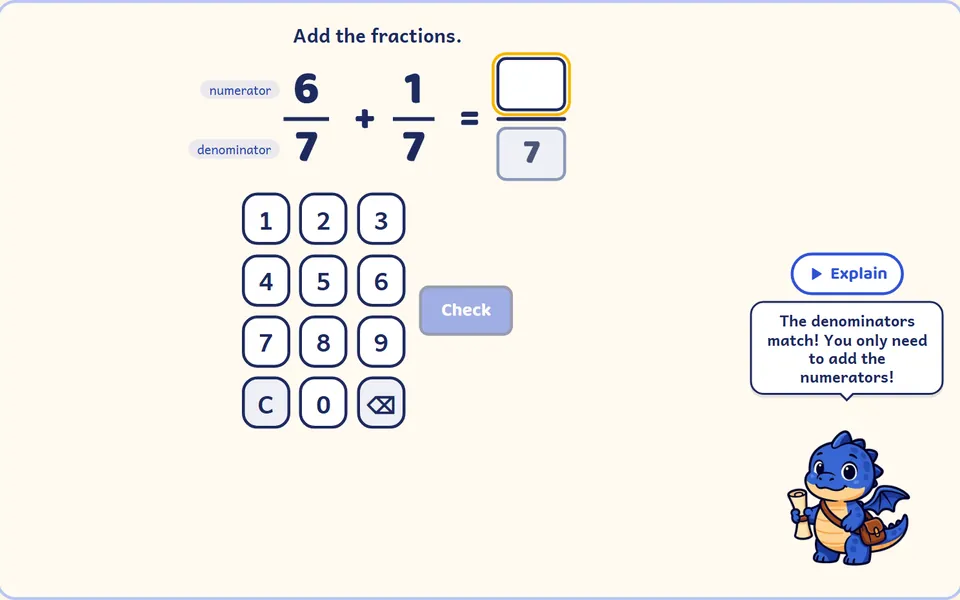
Fraction Bridge in MathQuest: 6/7 + 1/7 with a number pad for the answer.

What is your child learning?

Children explore equivalent fractions and link some fractions with decimal notation. They position fractions on number lines and notice that different descriptions can mean the same amount.

Two quarters and one half can represent the same quantity. Being able to show that with a picture helps children develop reasoning rather than relying on memorised rules.

How MathQuest helps

Number-Line Jump asks children to place fractions, including mixed numbers such as 1 1/4, on a number line. Fraction Bridge adds and subtracts fractions with the same denominator.

MathQuest games: Number-Line Jump, Fraction Bridge

Try it at home

Fold paper into quarters and halves, shade equal areas and place the fractions on a line from zero to one.

Australian Curriculum: AC9M4N03, AC9M4N04

4. Measurement, area, perimeter and time

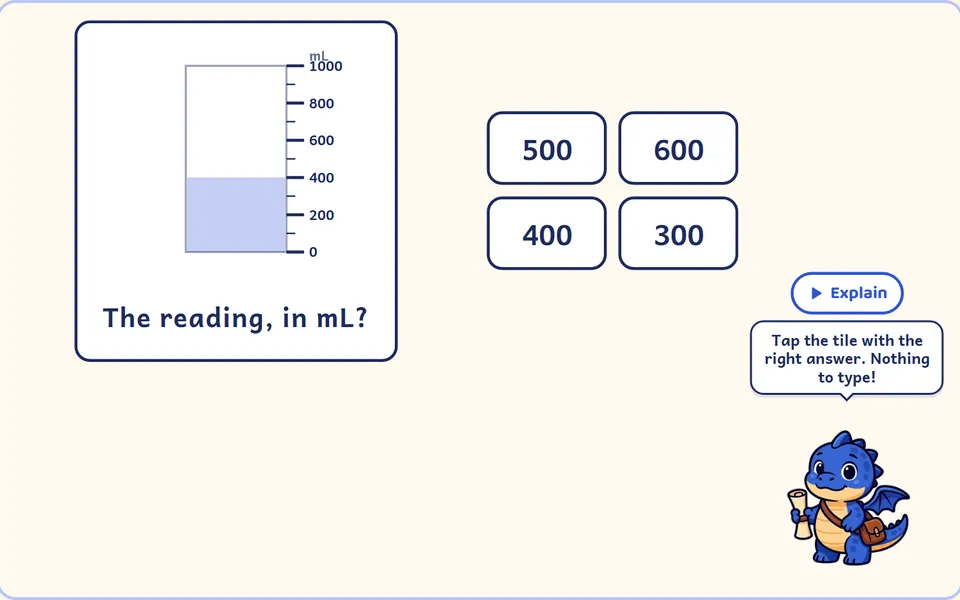
Measure it in MathQuest: a measuring jug marked in millilitres and the question "The reading, in mL?".

What is your child learning?

Children use scaled measuring tools and suitable units. They estimate and measure length, mass, capacity and temperature, and begin working with area and perimeter in practical ways. They also convert between units of time in familiar situations.

Perimeter means the distance around a shape, while area describes the space it covers. Seeing the difference is easier when children can touch or draw an example.

How MathQuest helps

Measure it asks children to read scales for mass, capacity and temperature. Geometry asks them to find an area by counting squares, and Work out the time asks how long it is between two times, across am and pm.

MathQuest games: Measure it, Geometry, Work out the time

Try it at home

Draw a rectangle on grid paper. Count the outside edges and the squares inside. Ask which number describes the fence and which describes the floor.

Australian Curriculum: AC9M4M01, AC9M4M02, AC9M4M03

5. Maps, symmetry and directions

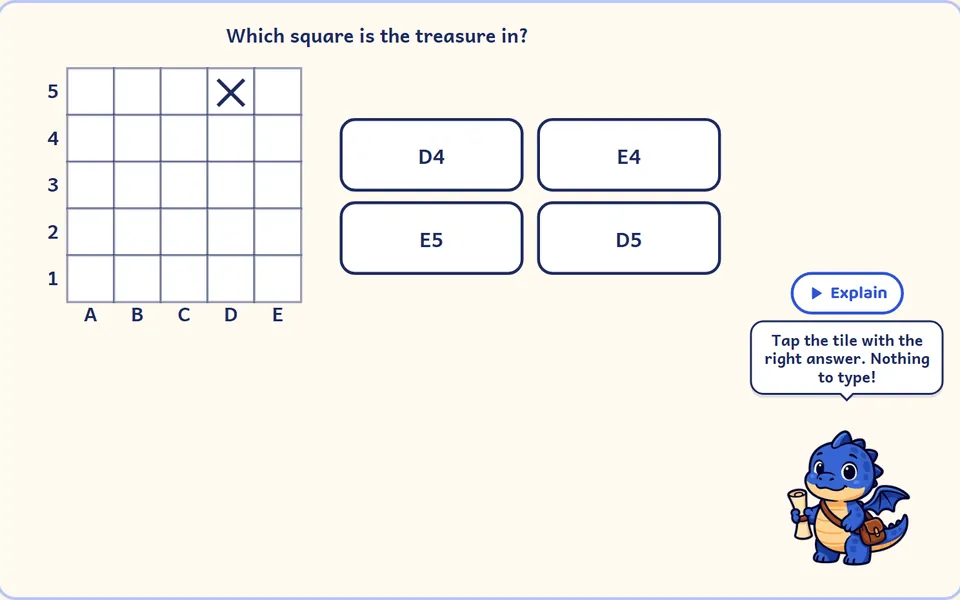
Find the spot in MathQuest: a grid with an X in one square and the question "Which square is the treasure in?".

What is your child learning?

Children use grid references to describe locations and practise giving accurate directions. They identify line and rotational symmetry in shapes and patterns.

This skill is about noticing how a shape can match itself when folded or turned, and how a grid makes a position unambiguous to someone else.

How MathQuest helps

Find the spot asks children to give the grid reference of a square on a map. Sort the shapes asks which shapes have a line of symmetry.

MathQuest games: Find the spot, Sort the shapes

Try it at home

Draw a simple map on squared paper. Ask your child to give directions from one point to another, then fold paper shapes to explore lines of symmetry.

Australian Curriculum: AC9M4SP02, AC9M4SP03

6. Graphs, information and chance

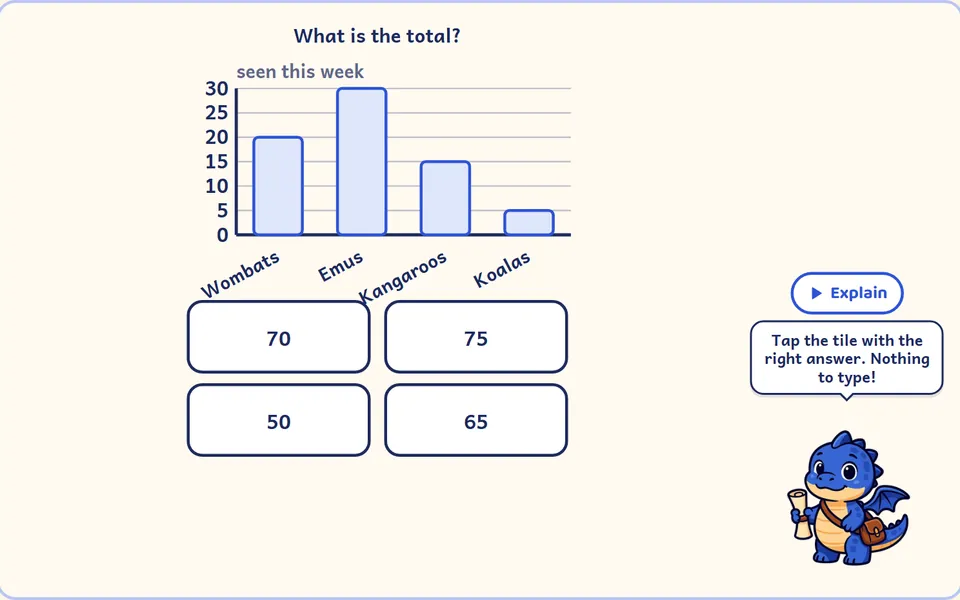
Read the graph in MathQuest: a column graph of wombats, emus, kangaroos and koalas, and the question "What is the total?".

What is your child learning?

Children collect and display information and discuss what their graphs show. They begin evaluating which display makes sense for the information and use repeated chance experiments to describe how results vary.

A graph is useful because it helps someone see a story in numbers. Children can learn to ask what is missing, what looks unusual and whether the display is fair.

How MathQuest helps

Read the graph asks questions about a column graph. Order the chances asks children to put events in order from least to most likely, and Sort the chances asks whether the chance changes from one go to the next.

MathQuest games: Read the graph, Order the chances, Sort the chances

Try it at home

Survey favourite lunchbox fruit, make a bar graph and ask what it tells you. Roll a die 20 times and compare results with your prediction.

Australian Curriculum: AC9M4ST01, AC9M4ST02, AC9M4P01, AC9M4P02

Why MathQuest? Maths with a reason to keep exploring

Children are more likely to engage when a problem has a purpose. In MathQuest, each game finished moves your child along the map to the next island, and each map ends with a boss level.

Each game is five questions, usually a minute or two, so it is easy to fit into family life.

Skills come back on later maps, in different games and in each map's boss level, so children keep practising what they have learnt. That repetition is deliberate: understanding is built by practising and recognising a familiar idea. Our aim is for children to want another game because they're enjoying themselves.

Learning continues beyond the screen

Maths in a game should connect with maths in daily life. Talking about prices, following directions, comparing measurements and explaining a calculation are simple ways for parents to reinforce what children explore in MathQuest.

How can you help your Grade 4 child at home?

You don't have to reteach the school day. Choose one ordinary activity and ask your child to explain their thinking. You might say, “How did you work that out?” or “Does that answer seem about right?” Let them use drawings, objects, a number line or another method that makes sense to them.

Keep it relaxed. When children are tired or frustrated, another time may work better. The point is to make the learning feel understandable and useful, not to race through worksheets.

Common questions from parents

What should my child know in Grade 4 maths?

The Year 4 Australian Curriculum includes the number, operations, patterns, measurement, space and data concepts explained above. Children learn these across the school year. Ask your child's teacher which skills are being taught now and what support would be helpful.

Is Grade 4 the same as Year 4?

Yes. In Victoria, families often say Grade 4. The Australian Curriculum calls the same year level Year 4.

What if my child finds a topic difficult?

Start with a smaller number or simpler example. Try drawing the problem or using objects to show what's happening. If difficulty continues or is affecting your child's confidence, their teacher can help identify a suitable next step.

Does my child need to practise maths every day?

There is no single practice length that suits every child. A short, useful activity at a relaxed time can be easier to repeat than a long session. Follow your child's needs and their teacher's guidance.

Does MathQuest replace maths lessons?

No. MathQuest is intended to complement classroom learning and give children another way to practise and apply maths through play.

Let their next maths adventure begin

Whether your child is learning a new number strategy, finding a fraction or reasoning through a measurement problem, every small success is another step forward. MathQuest aims to make those moments part of an enjoyable adventure.

Short games. Real maths skills. A world waiting to be explored.

The first six games are free with a free account. After that, MathQuest is $4.99 a month or $29 a year.