Open the game ▸

Grade 6 Maths Games for Kids Learning Through Play with MathQuest

Practical Year 6 maths, explained simply for parents

Grade 6 is a chance to bring many of the ideas from primary school together. Children use negative numbers, fractions, decimals, percentages, coordinates and data to make decisions. The aim is not just a correct answer but being able to explain the approach and check whether it makes sense.

MathQuest is designed around short adventures where children use maths to solve problems and keep exploring. This guide explains what your child is learning, why the skills matter and how you can help without turning home into another classroom.

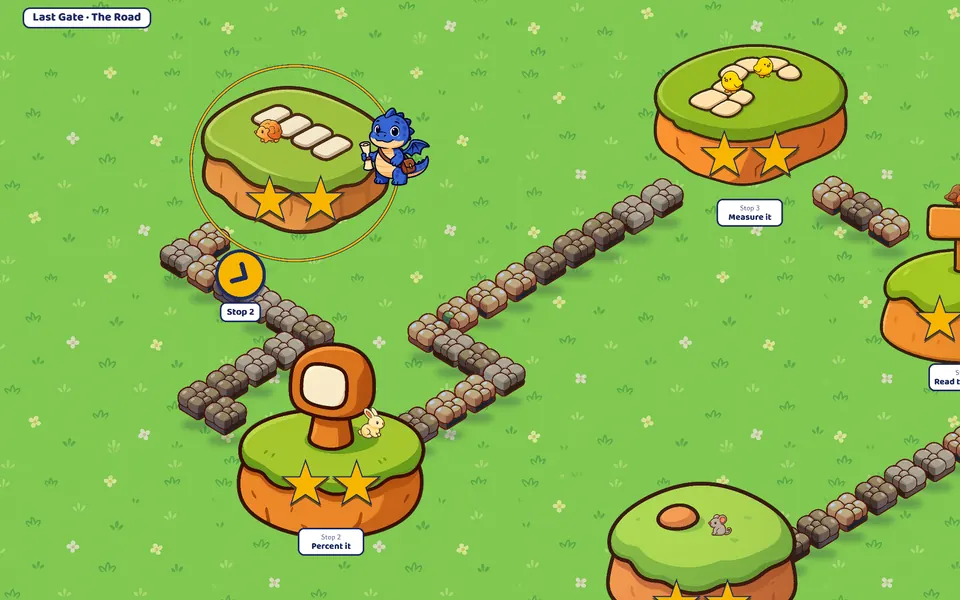
A Year 6 map in MathQuest: grassy islands joined by a cobbled path, each island a game, with Daviel the dragon on the first one.

What maths does your child learn in Grade 6?

The Australian Curriculum calls this level Year 6. The six areas below translate its maths content into everyday language. Children work through these ideas over the year, at different speeds. They are not a test you need to give your child at home.

1. Positive and negative numbers, coordinates
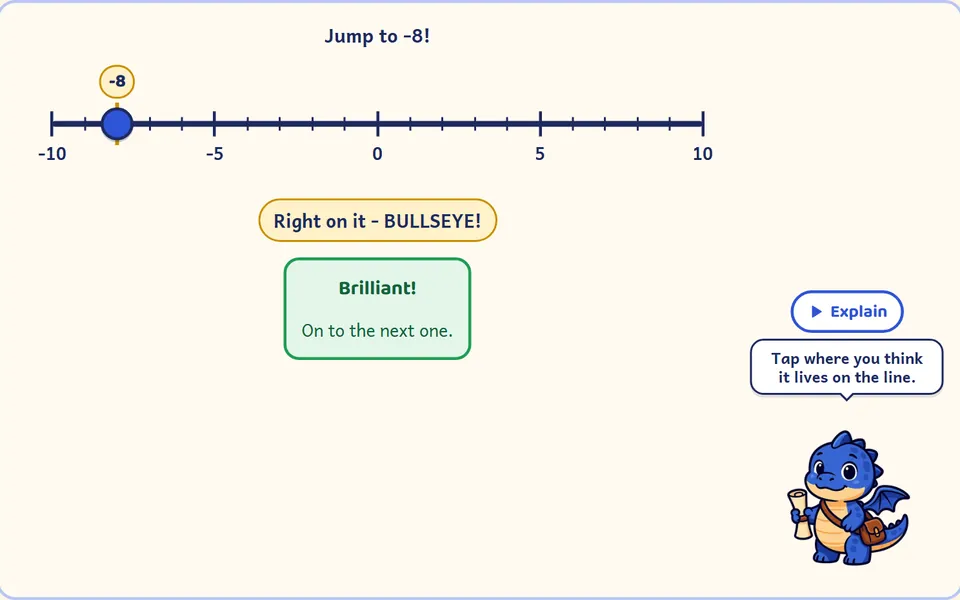
Number-Line Jump in MathQuest: -8 placed on a line from -10 to 10, with "Right on it - BULLSEYE!".

What is your child learning?

Children work with integers, including numbers below zero. They can locate numbers on a line and understand ordered pairs of coordinates across four quadrants of a Cartesian plane.

For example, moving from minus three to plus two is a five-step change. Seeing it on a number line makes the movement clear. Coordinates help them describe an exact point on a map.

How MathQuest helps

Number-Line Jump asks children to place positive and negative numbers on a number line. Find the spot asks for the coordinates of a point in any of the four quadrants.

MathQuest games: Number-Line Jump, Find the spot

Try it at home

Draw a number line from -5 to 5 and move a counter. Make a coordinate grid and ask your child to plot a point in each quadrant.

Australian Curriculum: AC9M6N01, AC9M6SP02
2. Factors, prime numbers and efficient calculations

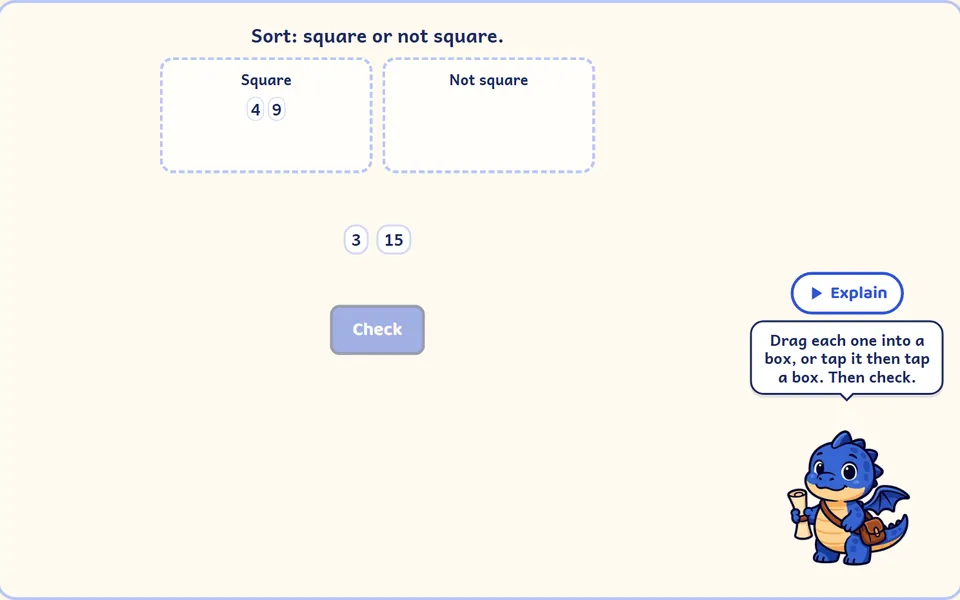
Sort the numbers in MathQuest: 4 and 9 sorted into Square, with 3 and 15 still to sort into Square or Not square.

What is your child learning?

Children explore prime, composite and square numbers and use this knowledge to solve calculations. They also apply rules to find missing values in number sentences and work through several steps.

A prime number has exactly two positive factors: one and itself. Seeing which numbers can be arranged into equal rectangular arrays makes the idea more practical.

How MathQuest helps

Sort the numbers asks children to sort numbers as prime or composite, and as square or not square. Work it out practises the order of operations, including brackets, and finding a missing number in a number sentence.

MathQuest games: Sort the numbers, Work it out

Try it at home

Use 12, 13 and 16 buttons. Try arranging each amount into equal rows and talk about which numbers have more than two factors.

Australian Curriculum: AC9M6N02, AC9M6A02

3. Fractions and decimals working together

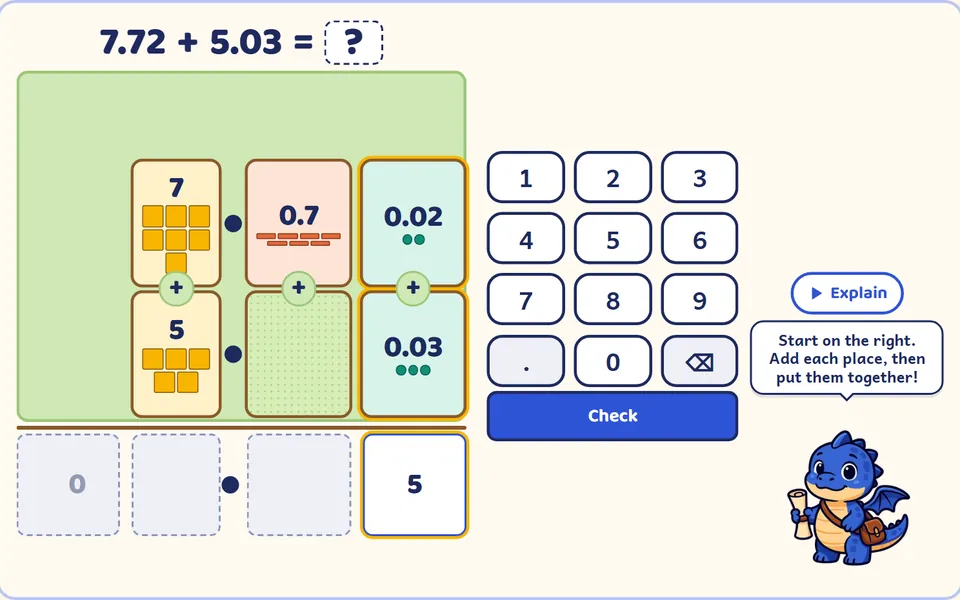
Decimal sums in MathQuest: 7.72 + 5.03 laid out as ones, tenths and hundredths, with 5 typed in the hundredths place and a number pad for the rest.

What is your child learning?

Children compare and order common fractions, add and subtract fractions with related denominators and calculate using decimal numbers. They choose strategies and use estimation to check their answers.

A half and a quarter can be combined into three quarters. Seeing the fractions on a line or with diagrams helps children explain the relationship rather than treating the fractions as two unrelated symbols.

How MathQuest helps

Number-Line Jump asks children to place fractions such as 5/8 on a number line. Decimal sums adds and subtracts decimals one place at a time, so the places stay lined up, and Place value multiplies and divides decimals by 10, 100 and 1000.

MathQuest games: Number-Line Jump, Decimal sums, Place value

Try it at home

Draw a strip divided into quarters, colour one half and another quarter, then ask how much is coloured. Try the same idea on a number line.

Australian Curriculum: AC9M6N03, AC9M6N04, AC9M6N05, AC9M6N06

4. Percentages, discounts and money decisions

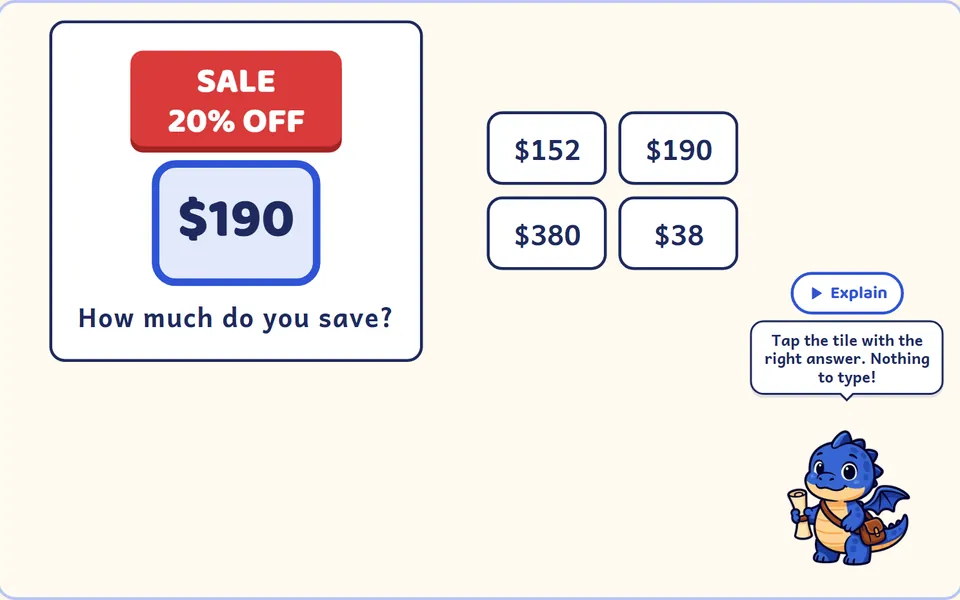
Percent it in MathQuest: a $190 price tag with a red SALE 20% OFF ribbon, the question "How much do you save?" and four money tiles.

What is your child learning?

Children connect fractions, decimals and percentages and use them to solve everyday problems, including discounts. They can estimate whether the result is sensible before choosing a method.

If an item costs $40 and is 25% off, a child can see that 25% is a quarter. A quarter of $40 is $10, so the discounted price is $30. This is maths they can use outside school.

How MathQuest helps

Percent it shows a price tag with a sale ribbon, such as 20% off $190, and asks how much you save. What are the chances? asks them to write a chance as a fraction, a decimal or a percentage.

MathQuest games: Percent it, What are the chances?

Try it at home

Look at a pretend sale brochure and ask how much a 10%, 25% or 50% discount changes a price. Discuss the saving and the final cost.

Australian Curriculum: AC9M6N07

5. Measurement, area, angles and timetables

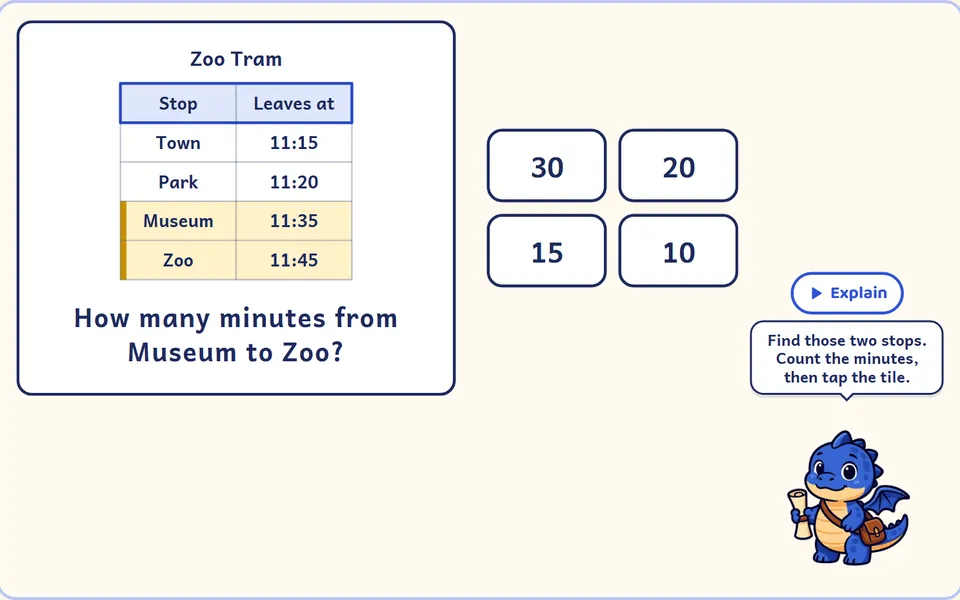
Work out the time in MathQuest: a tram timetable and the question "How many minutes from Museum to Zoo?".

What is your child learning?

Children convert between familiar metric units, use the area formula for a rectangle, reason about related angles and interpret timetables and journeys.

They begin choosing measurements that fit the problem. A room is sensibly measured in metres, and a long journey in kilometres. They also use timetables to work out durations and plan connections.

How MathQuest helps

Geometry asks children to find the area of rectangles. Measure it converts between metric units, and Work out the time asks how long a journey takes between two stops on a timetable.

MathQuest games: Geometry, Measure it, Work out the time

Try it at home

Measure a rectangular room and multiply length by width for area. Use a public transport timetable to plan a pretend trip and work out how long it would take.

Australian Curriculum: AC9M6M01, AC9M6M02, AC9M6M03, AC9M6M04

6. Data, chance and checking claims

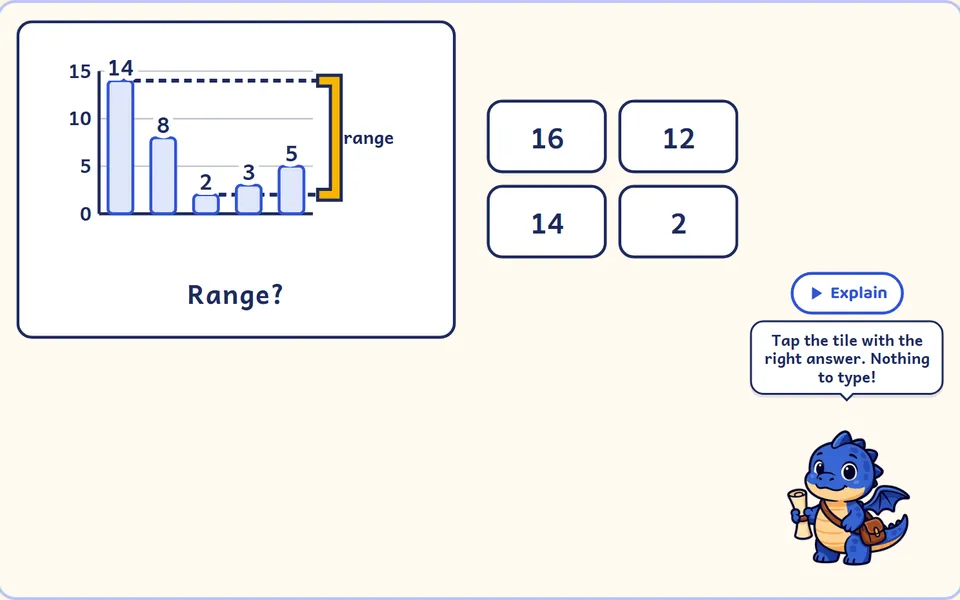
Read the graph in MathQuest: a column graph with a bracket from the shortest bar to the tallest, the question "Range?" and four number tiles.

What is your child learning?

Children collect and compare numerical and categorical data, including reading distributions and considering how information can be presented. They explore probability, run chance experiments and compare results with what they expected.

This is also a chance to teach a valuable habit: not every number or graph tells the whole story. Children learn to ask how information was collected and whether the conclusion is supported.

How MathQuest helps

Read the graph asks children to find the range on a column graph, from the shortest bar to the tallest. Place the chance asks them to place a chance on a scale from 0 to 1, and What are the chances? asks them to write it as a fraction, decimal or percentage.

MathQuest games: Read the graph, Place the chance, What are the chances?

Try it at home

Compare two simple charts from the same data, or toss a coin 30 times and record the outcomes. Ask whether what happened was close to what you expected.

Australian Curriculum: AC9M6ST01, AC9M6ST02, AC9M6P01, AC9M6P02

Why MathQuest? Maths with a reason to keep exploring

Children are more likely to engage when a problem has a purpose. In MathQuest, each game finished moves your child along the map to the next island, and each map ends with a boss level.

Each game is five questions, usually a minute or two, so it is easy to fit into family life.

Skills come back on later maps, in different games and in each map's boss level, so children keep practising what they have learnt. That repetition is deliberate: understanding is built by practising and recognising a familiar idea. Our aim is for children to want another game because they're enjoying themselves.

Learning continues beyond the screen

Maths in a game should connect with maths in daily life. Talking about prices, following directions, comparing measurements and explaining a calculation are simple ways for parents to reinforce what children explore in MathQuest.

How can you help your Grade 6 child at home?

You don't have to reteach the school day. Choose one ordinary activity and ask your child to explain their thinking. You might say, “How did you work that out?” or “Does that answer seem about right?” Let them use drawings, objects, a number line or another method that makes sense to them.

Keep it relaxed. When children are tired or frustrated, another time may work better. The point is to make the learning feel understandable and useful, not to race through worksheets.

Common questions from parents

What should my child know in Grade 6 maths?

The Year 6 Australian Curriculum includes the number, operations, patterns, measurement, space and data concepts explained above. Children learn these across the school year. Ask your child's teacher which skills are being taught now and what support would be helpful.

Is Grade 6 the same as Year 6?

Yes. In Victoria, families often say Grade 6. The Australian Curriculum calls the same year level Year 6.

What if my child finds a topic difficult?

Start with a smaller number or simpler example. Try drawing the problem or using objects to show what's happening. If difficulty continues or is affecting your child's confidence, their teacher can help identify a suitable next step.

Does my child need to practise maths every day?

There is no single practice length that suits every child. A short, useful activity at a relaxed time can be easier to repeat than a long session. Follow your child's needs and their teacher's guidance.

Does MathQuest replace maths lessons?

No. MathQuest is intended to complement classroom learning and give children another way to practise and apply maths through play.

Let their next maths adventure begin

Whether your child is learning a new number strategy, finding a fraction or reasoning through a measurement problem, every small success is another step forward. MathQuest aims to make those moments part of an enjoyable adventure.

Short games. Real maths skills. A world waiting to be explored.

The first six games are free with a free account. After that, MathQuest is $4.99 a month or $29 a year.