Open the game ▸

Grade 3 Maths Games for Kids Learning Through Play with MathQuest

Practical Year 3 maths, explained simply for parents

Grade 3 is often when maths begins to feel more advanced. Children use bigger numbers, build their multiplication skills, explore fractions and work out how to check an answer. These concepts can be easier when children see them in everyday situations rather than just on a worksheet.

MathQuest is designed to make maths useful in a short adventure. Children solve problems and explore. Here's what your child learns, which MathQuest games practise it and what you can try at home.

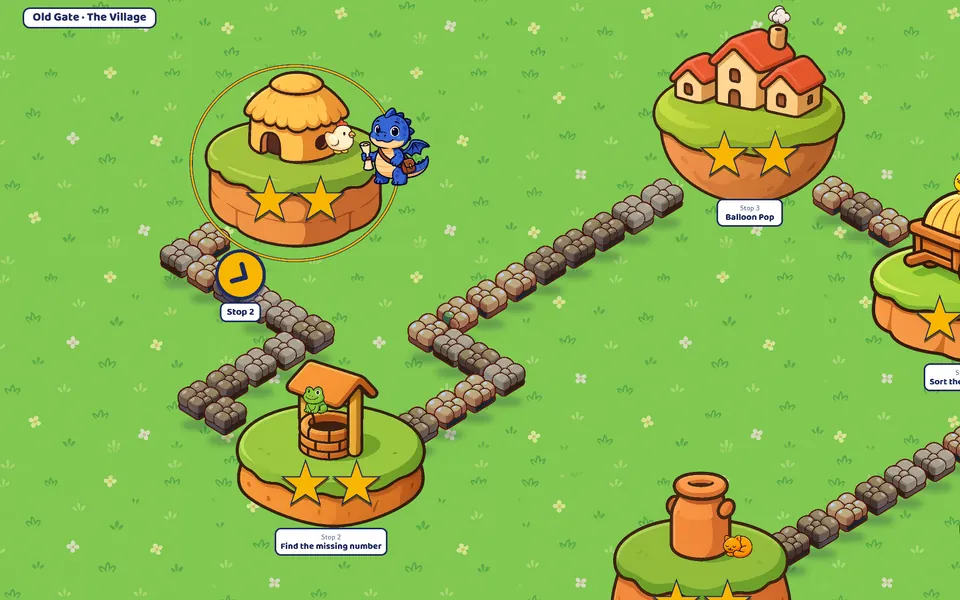
A Year 3 map in MathQuest: grassy islands joined by a cobbled path, each island a game, with Daviel the dragon on the first one.

What maths does your child learn in Grade 3?

The Australian Curriculum calls this Year 3. These six areas explain the learning in everyday language. Children develop these skills across the school year, at different rates, rather than mastering everything at once.

1. Numbers beyond 10,000

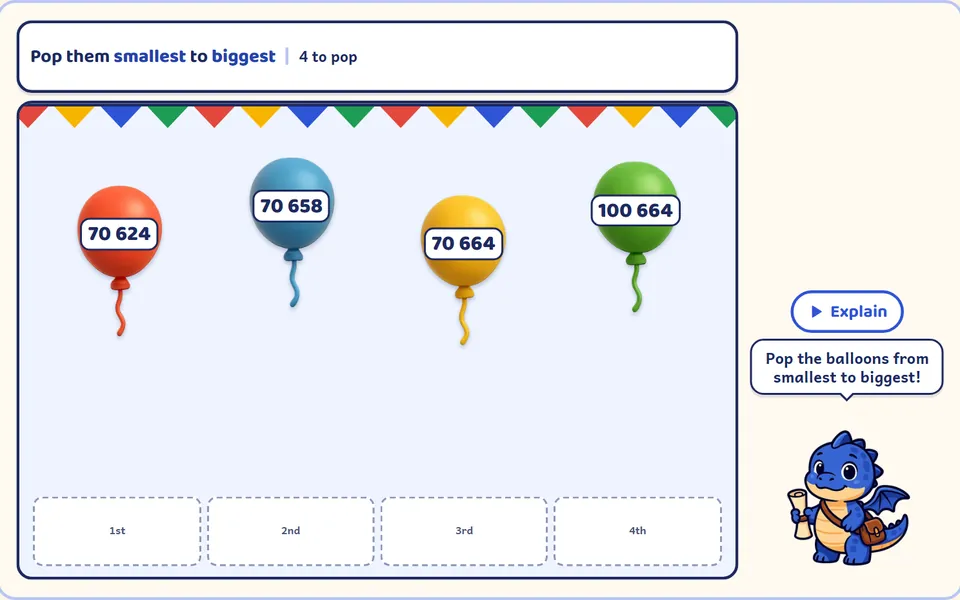
Place value in MathQuest: four balloons, 70 624, 70 658, 70 664 and 100 664, to pop from smallest to biggest.

What is your child learning?

Children learn to read, represent and order numbers beyond 10,000. They also use place value to break up two- and three-digit numbers when calculating. For example, 348 can be seen as 300 plus 40 plus 8.

A bigger number can look intimidating. Breaking it into familiar parts makes it easier to compare and reason about. Ask why 12,450 is larger than 12,405; the explanation matters as much as the answer.

How MathQuest helps

Balloon Pop and Place value ask children to order numbers into the tens of thousands, where only one digit may differ. Round it rounds numbers to the nearest ten.

MathQuest games: Balloon Pop, Place value, Round it

Try it at home

Compare distances on a map or prices in a catalogue. Build 348 with paper hundreds, tens and ones, then rearrange it another way.

Australian Curriculum: AC9M3N01
2. Adding, subtracting and sensible answers

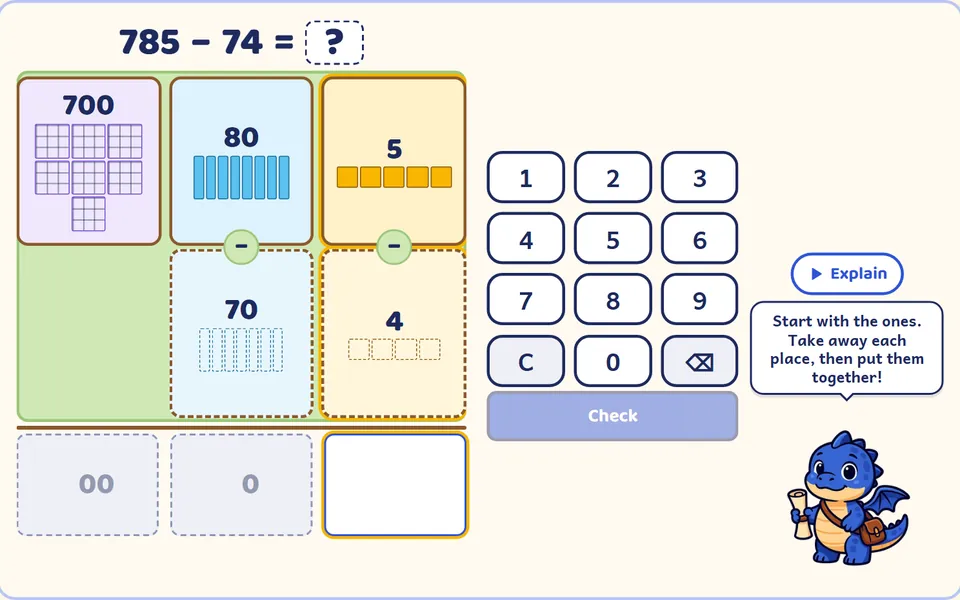
Take away in MathQuest: 785 - 74 laid out as hundreds, tens and ones, with a number pad to work each place.

What is your child learning?

Children add and subtract two- and three-digit numbers with strategies that use place value. They learn to estimate, split numbers, bridge tens and hundreds, and check whether an answer makes sense.

For example, 198 plus 25 could be solved as 200 plus 23. A child who can explain this is showing a useful understanding of how numbers work, not just memorising a sequence of steps.

How MathQuest helps

Take away works through three-digit subtraction one place at a time, ones first. Find the missing number asks children to find the missing number in sums such as 95 - ? = 60, which links adding and subtracting, and Adding numbers practises adding tens to three-digit numbers.

MathQuest games: Take away, Find the missing number, Adding numbers

Try it at home

Make a pretend shopping list, estimate its cost and then calculate the total. Ask whether the exact answer is close to the estimate.

Australian Curriculum: AC9M3N03, AC9M3N05, AC9M3N06, AC9M3A01, AC9M3A02

3. Multiplication, division and times tables

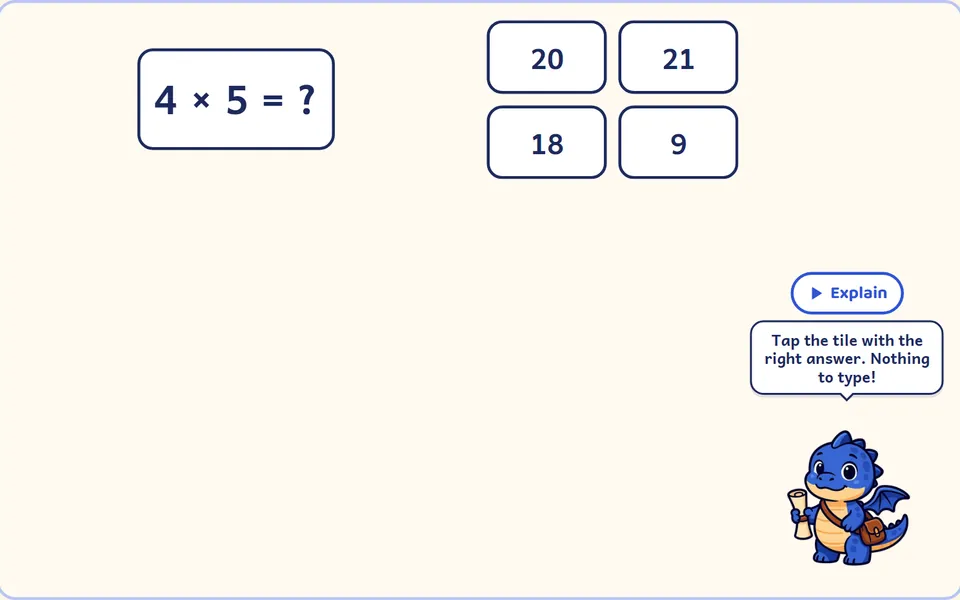
Recall in MathQuest: "4 × 5 = ?" with four number tiles.

What is your child learning?

In Grade 3, children build fluency with multiplication facts for twos, threes, fours, fives and tens, and learn related division facts. Arrays, equal groups and repeated addition help make the facts understandable.

Three rows of four apples show why three times four is twelve. The same picture also explains how twelve can be shared into three equal groups of four. Seeing that connection can make number facts more memorable.

How MathQuest helps

Recall and Divide by X practise the 2, 3, 4, 5 and 10 facts and their division facts. Long multiplication walks through two-digit by one-digit multiplication one step at a time.

MathQuest games: Recall, Divide by X, Skip count, Long multiplication

Try it at home

Arrange 24 Lego bricks into rows. Ask how many different arrangements work, and which multiplication fact each one represents.

Australian Curriculum: AC9M3N04, AC9M3A03

4. Fractions and equal parts

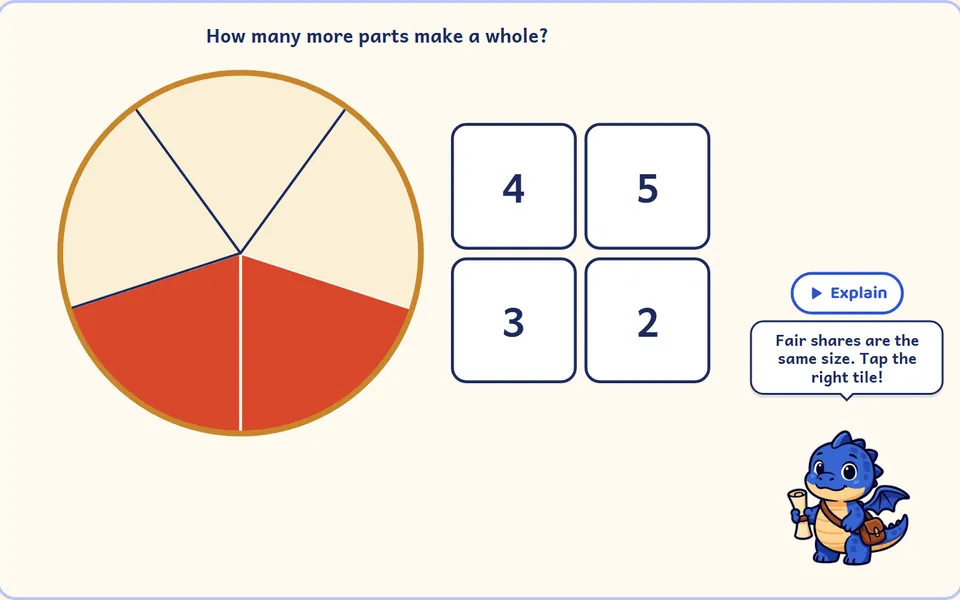
Fair shares in MathQuest: a circle cut into five equal parts with two coloured, the question "How many more parts make a whole?" and the numbers 2, 3, 4 and 5 to choose from.

What is your child learning?

Children learn to recognise unit fractions such as halves, thirds, quarters, fifths and tenths, as well as multiples of these fractions. They learn to show fractions with pictures, objects and number lines.

A fraction is a number, not just a piece of cake. Three quarters belongs between one half and one whole on a number line. Showing this visually makes the idea easier to understand.

How MathQuest helps

Fair shares asks children to shade a third or a fifth of a shape and name the fraction shaded, to shade more than one part, such as three quarters or two fifths, and to work out how many more parts make a whole.

MathQuest games: Fair shares

Try it at home

Fold a sheet into quarters and colour three parts. Ask what fraction is coloured and where it belongs on a number line.

Australian Curriculum: AC9M3N02

5. Measurement, time, money and angles

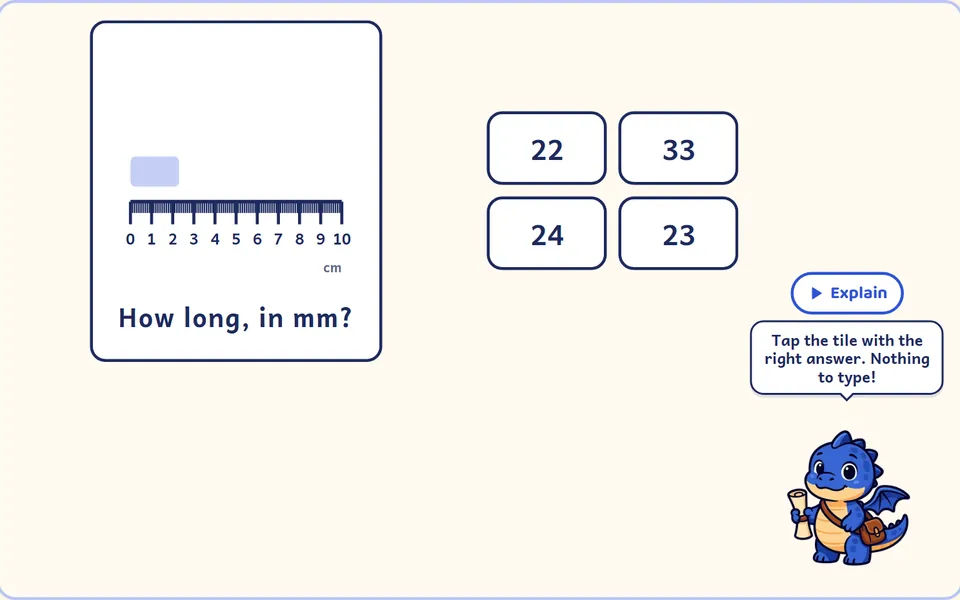
Measure it in MathQuest: a bar above a centimetre ruler and the question "How long, in mm?".

What is your child learning?

Children use familiar metric units to estimate and measure things around them. They compare angles to right angles, represent money values in different ways and talk about the duration of events.

Children begin judging what is reasonable: a pencil is measured in centimetres, not kilometres. Estimating first is useful because it helps them notice when an answer cannot be right.

How MathQuest helps

Measure it asks which unit fits, then has children read a ruler in centimetres and millimetres. Children read clocks to the minute in Tell the time, convert between units of time in Work out the time, write dollars as cents in Money, and compare angles with a right angle in Turns and angles.

MathQuest games: Measure it, Tell the time, Work out the time, Money, Turns and angles

Try it at home

Estimate the length of a book before measuring it. Find right angles in doors or tables, or show the same dollar value using different coins.

Australian Curriculum: AC9M3M01, AC9M3M02, AC9M3M03, AC9M3M04, AC9M3M05, AC9M3M06

6. Shapes, maps, data and chance

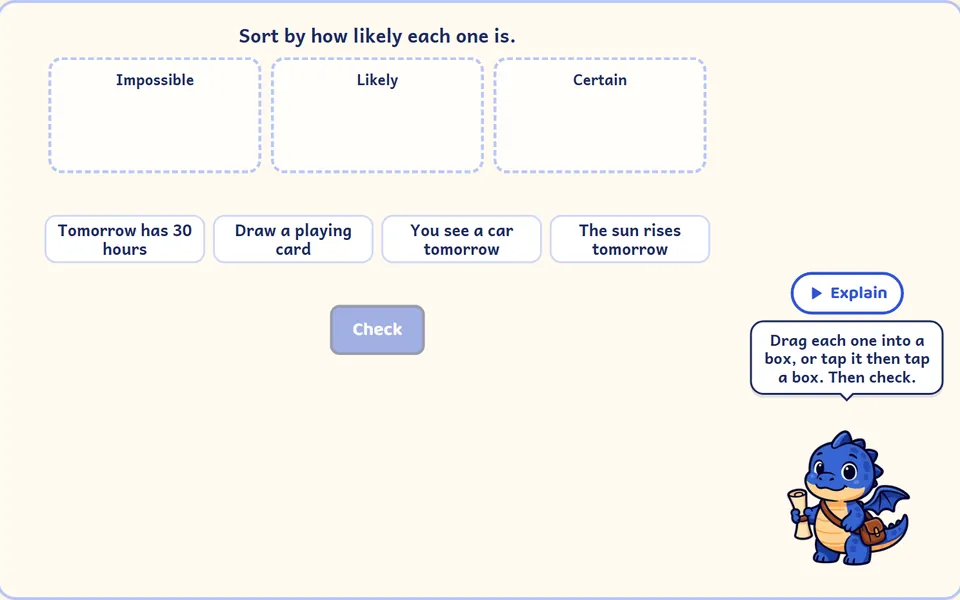
Sort the chances in MathQuest: events such as "The sun rises tomorrow" to sort into impossible, likely and certain.

What is your child learning?

Children examine three-dimensional objects, use maps, collect and compare information, and explore chance through everyday experiments. They learn to describe what the results show, not just record a number.

If they toss a coin ten times, they might not get five heads and five tails. Talking about why results vary gives them an early understanding of probability and evidence.

How MathQuest helps

Sort the shapes asks children to sort 3D objects by their faces and surfaces. Sort the chances asks how likely everyday events are, What are the chances? asks them to read the results of a spinner, and Read the graph asks questions about a table.

MathQuest games: Sort the shapes, Sort the chances, What are the chances?, Read the graph

Try it at home

Draw a treasure map of your home, construct a paper box, or toss a coin ten times and record the results in a tally.

Australian Curriculum: AC9M3SP01, AC9M3SP02, AC9M3ST02, AC9M3P01, AC9M3P02

Why MathQuest? Maths with a reason to explore

Each game is five questions, usually a minute or two.

Each game finished moves your child along the map to the next island, and each map ends with a boss level. Skills come back on later maps and in different games, giving children opportunities to practise without every attempt feeling like another worksheet.

Our goal is for children to choose another game because they're enjoying the game, not just because Mum or Dad has asked them to practise.

Maths that continues beyond the screen

You can build on these ideas with shopping, cooking, measuring and play. Explaining how they reached an answer helps children use what they learn rather than simply remember it.

How can you help your Grade 3 child at home?

You don't need to teach another school lesson. Ask your child, “How did you work that out?” or “Does that seem about right?” Let them use drawings, Lego or a number line. If they are frustrated or tired, try another time.

Common questions from parents

What should my child know in Grade 3 maths?

Year 3 covers larger numbers, addition and subtraction, multiplication and division facts, fractions, measurement, shape, maps and data. These develop during the year. Ask your child's teacher which topics they are focusing on now.

Is Grade 3 the same as Year 3?

Yes. Grade 3 is commonly used in Victoria; the Australian Curriculum calls the same level Year 3.

What if my child finds times tables difficult?

Start with small groups of objects or arrays that your child can see and move. Understanding the groups behind a multiplication fact can make it easier to remember.

How long should we practise?

Start with a short activity at a time when your child is relaxed. A few enjoyable minutes can be more useful than a long, stressful session.

Does MathQuest replace school maths?

No. MathQuest is designed to complement school learning with playful opportunities to practise and apply maths.

Let their maths adventure begin

Whether your child is reading a clock, measuring an object or working through multiplication, every small success helps build confidence.

Short games. Real maths skills. A world waiting to be explored.

The first six games are free with a free account. After that, MathQuest is $4.99 a month or $29 a year.